Five exercises, a rowing machine and a garage. No gym required.
Twice a week I do a short strength session at home. Five dumbbell exercises, a rowing machine interval workout, about forty minutes in total. No membership. No subscription. No commute. Here's exactly what I do, and how I got here.
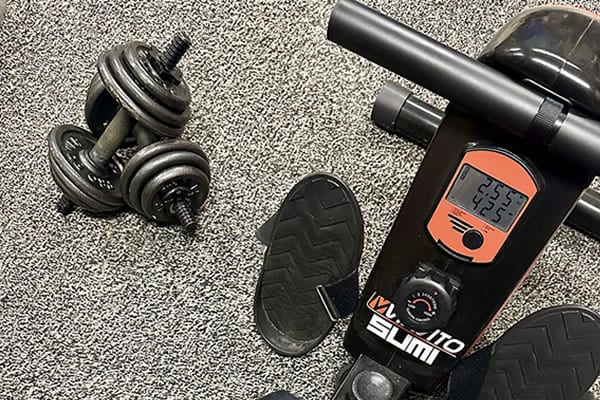
I have a rowing machine that I found on Facebook Marketplace. I don't know how much use the previous owners got from it, but I suspect the answer is "not much". It was barely used and sold at a fraction of its original price, in the way that exercise equipment tends to be when enthusiasm meets reality.
Their loss. It now sits in my garage alongside a set of dumbbells and a small square of floor space, and twice a week this modest collection of kit constitutes my entire strength and conditioning setup.
I mention this because I think there's a persistent myth that effective strength training requires a gym, the equipment, the environment, the subscription, the drive there and back. In my experience, it doesn't. It requires a plan, a bit of consistency, and enough floor space to do a deadlift without knocking anything over.
Where the idea came from
I came across an article in the Independent about Olympic BMX silver medallist Kieran Reilly's go-to rowing machine workout, a series of hard intervals that he uses as a cornerstone of his conditioning. The workout in the article was designed for someone operating at a rather different level of fitness than me, but the underlying structure was immediately appealing: short, hard efforts on the rower, proper rest between each one, and a defined endpoint. Simple to follow, impossible to cheat yourself on.
I adapted it for someone who is 64, runs three times a week, and is not preparing for an Olympic BMX final. Then I added the dumbbell work around it. The result is the session I've been doing twice a week ever since.
The rowing machine workout
The rowing machine comes first, while I'm fresh. The session is straightforward:
The five intervals are the session. Two minutes at maximum resistance is genuinely hard, harder than it sounds if you've not tried it, and the one-minute rest between each one is just enough to recover sufficiently to go again without it being easy. By the fifth interval, the one-minute rest feels considerably shorter than the first one did.
The key, which the Reilly article made clear, is consistency across intervals rather than going too hard early. The aim is for each two-minute effort to feel roughly the same, not to sprint the first one and crawl through the last. After a few sessions you develop a sense of the pace that makes this work. It takes a little trial and error to find it.
The dumbbell exercises
After the rowing, I move straight into five dumbbell exercises. Three sets of eight to ten reps each. The movements I've chosen cover the whole body and between them work virtually every major muscle group, which is the point of choosing them.
Goblet squat
Quads · glutes · hamstrings · core
Hold a single dumbbell vertically at chest height with both hands. Feet slightly wider than shoulder-width, toes turned out slightly. Squat down keeping the chest up and the dumbbell close to your body, until thighs are at least parallel to the floor. Drive back up through the heels. The dumbbell held in front naturally encourages an upright posture, one of the reasons this is a better starting point than a barbell squat for most people.
Deadlift
Hamstrings · glutes · lower back · core
Hold a dumbbell in each hand in front of your thighs. Hinge at the hips, pushing them back rather than bending the knees, lowering the dumbbells down your legs while keeping your back flat and your chest up. Feel the stretch in the hamstrings, then drive the hips forward to return to standing. This is one of the most functional movements there is: essentially the same pattern as picking something up from the floor safely.
Chest press
Chest · shoulders · triceps
Lie on your back. On the floor is fine, a bench gives more range of motion. Hold a dumbbell in each hand at chest height, elbows at roughly 45 degrees from your body. Press both dumbbells upward until arms are extended, then lower under control. The controlled lowering (the eccentric phase) is at least as important as the pressing.
Overhead press
Shoulders · upper back · triceps · core
Stand or sit with a dumbbell in each hand at shoulder height, palms facing forward. Press both upward until arms are fully extended overhead, then lower under control. Requires and develops shoulder mobility, something that tends to decline with age if not actively maintained. Keep the core braced throughout to protect the lower back.
Bent-over row
Upper back · lats · rear shoulders · biceps
Hinge forward at the hips until your torso is roughly parallel to the floor, holding a dumbbell in each hand. Pull both dumbbells up toward your hips, leading with the elbows, squeezing the shoulder blades together at the top. Lower under control. An essential counterbalance to the pressing movements. The combination of press and row works the pushing and pulling muscles in the upper body symmetrically, which matters for posture as much as strength.
Why these five?
Between them, these movements cover every major muscle group: legs and glutes, back, chest, shoulders. The squat and deadlift are lower body. The chest press and overhead press cover pushing. The row covers pulling. There's nothing exotic here. These are among the most well-established resistance exercises there are, chosen because they work and because they're safe to do without supervision if your form is reasonable.
The goblet squat in particular is worth highlighting for anyone who's nervous about squatting. The dumbbell held in front naturally encourages an upright posture and makes it considerably more forgiving than a barbell squat. You can learn the movement pattern correctly without needing anyone to spot you or worry about a heavy bar on your back.
Why strength training at all?
The running keeps my cardiovascular fitness where it needs to be. The strength work does something different, something that becomes more important, not less, as you get older.
From around the age of 30, we begin to lose muscle mass gradually, a process called sarcopenia that accelerates after 60 if nothing is done about it. Loss of muscle mass means loss of strength, balance and metabolic function. It's one of the primary mechanisms by which people become physically frail in later life, and it's substantially reversible with resistance training even into the 70s and 80s. This is not a fringe view. It's mainstream exercise science, and the research on it is unusually consistent.
You don't need a gym to address it. You need resistance, progressive overload, and consistency. Dumbbells provide all three.
On form and starting out: I'm not a personal trainer and these descriptions aren't a substitute for seeing the movements done correctly. If you're new to any of these exercises, YouTube has thousands of good demonstration videos. Search the exercise name with "form" or "tutorial." Getting the movement pattern right before adding weight is worth the time. If anything causes sharp pain rather than muscular effort, stop.
The equipment question
A set of adjustable dumbbells covers everything here. You don't need multiple sets at different weights. Adjustable ones let you change the load between exercises and as you get stronger over time. A decent set costs somewhere between £50 and £150 depending on the weight range and brand. The rowing machine I found on Facebook Marketplace for a fraction of its new price. Barely used exercise equipment is one of the better bargains available if you're patient.
No gym membership. No subscription. No commute. Just a bit of floor space and about forty minutes, twice a week.
The results, after a couple of years of this, are not dramatic in the way that before-and-after photos suggest they should be. They're quieter than that. I'm stronger than I was. My posture is better. I don't get as tired carrying things. On the rowing machine, my interval times have gradually come down. None of this is remarkable. All of it matters.