Losing weight after 60 without losing your muscle
A new position statement on diets for weight loss has one finding that matters more to us than to the athletes it was written for: when weight comes off, muscle can go with it, unless you do something about it.
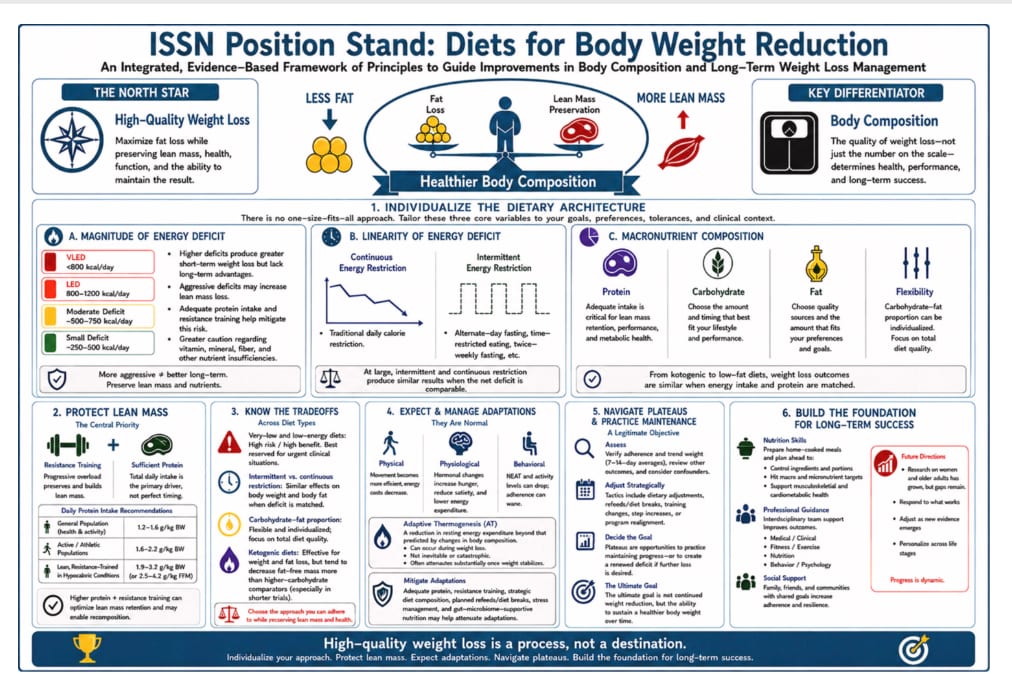
A new position statement from the International Society of Sports Nutrition (ISSN) landed this month, and I've spent a few evenings working through it. It's a long, dense paper called Diets for body weight reduction, published in the Journal of the International Society of Sports Nutrition, and it pulls together the evidence on every major way of losing weight: very low-calorie diets, intermittent fasting, keto, low-fat, high-protein, meal timing and more.
Most of it is written with athletes and gym-goers in mind. It's not a paper about people in their sixties and seventies, and I want to be clear about that. But one theme runs through the whole thing, and it matters more to us than to a twenty-five-year-old: when you lose weight, some of what you lose is muscle, unless you take steps to stop it.
Why losing muscle is a bad trade
The paper makes a distinction I hadn't seen put so plainly. "High-quality" weight loss means losing fat while keeping as much lean mass (mostly muscle) as possible. "Low-quality" weight loss takes a good deal of muscle with the fat.
The authors describe a knock-on effect they call collateral fattening. Lose a lot of lean tissue and the body seems to push back with a bigger appetite until it recovers, which can send body fat bouncing back above where it started. They also note that holding on to lean mass helps preserve energy expenditure, immune function and the way the body handles fuel.
For anyone over sixty, muscle is also the thing that gets you out of a chair, up the stairs and through a long walk with the dog. It's not worth trading away for a lower number on the scales.
"Whichever diet you choose, strength training and enough protein are what protect your muscle while the weight comes off."
My summary of the paper's main pointWhat the paper says about crash diets
Very low-calorie diets (under 800 kcal a day) and low-calorie diets (800 to 1,200) produce fast weight loss. They also tend to cost muscle: a loss of around a quarter of the weight shed as lean mass is commonly reported. And the advantage doesn't last. By one to two years later, people who dieted aggressively were not much better off than people who dieted gently, and weight regain is common.
Two findings stood out for our age group. In a 12-month trial of postmenopausal women with obesity, the group on severe restriction lost more bone density at the hip than the group on moderate restriction. Protein intake in that trial was only just above the official minimum and nobody was doing structured exercise, which the authors flag as a limitation. In a large 8-week trial of an 810 kcal diet, women lost more fat-free mass than men and reported more side effects, including constipation, dizziness and hair loss.
None of this means nobody should ever use these diets. The paper says they can be useful under supervision for people with obesity who need to lose a lot quickly. But for the rest of us, slower is kinder to muscle and bone.
Fasting, keto and meal timing
I was interested in this section because so much of what's said about fasting is hype. The evidence in the paper is fairly calm. Intermittent fasting, in its various forms, does about the same as ordinary calorie control. Any benefits seem to come from the weight loss itself, not from the fasting.
There was one caution. Alternate-day fasting may be the variant most likely to cost you muscle, because it can create a larger weekly deficit. In one trial, 92 per cent of the weight lost on steady daily restriction was fat, compared with only 46 per cent on alternate-day fasting with the same overall deficit. The authors suggest keeping fasting days to three a week or fewer and doing resistance training.
On keto, the paper says it works for weight loss, but that people on keto tend to lose more fat-free mass than people on higher-carbohydrate diets, especially in shorter trials, partly because of shifts in water and glycogen. And meal frequency, whether you eat two meals a day or six, makes little difference to weight. What may help muscle is having protein at three or more eating occasions a day.
The two things that do the protecting
The paper is blunt: resistance training and enough protein. Which diet you follow matters much less.
On protein, the long-standing official minimum (0.8 grams per kilo of body weight per day in the US guidelines the paper uses) is enough to prevent deficiency in a healthy, sedentary adult. The authors say it is unlikely to be optimal during exercise training, ageing or calorie restriction. For the general population they suggest 1.2 to 1.6 grams per kilo a day, and note the latest US Dietary Guidelines now recommend that range too. With resistance training, 1.6 to 2.2 grams per kilo may be the sweet spot for building and keeping muscle.
You'll see much higher numbers in the paper (up to 3.2 grams per kilo). Those are for lean, serious lifters who are dieting hard, and the authors say they may not apply to the rest of us. I wouldn't chase them.
As a rough example, for someone who weighs 70 kg and wants to hit the middle of the general range, that's about 84 to 112 grams of protein a day, against 56 grams at the old minimum. The paper says people with a lot of weight to lose should work from a target or "ideal" weight rather than their current weight.
Where does that much protein come from? Roughly: an egg has about 6 grams, a tin of tuna around 25, a pot of Greek yoghurt 15 to 20, and a palm-sized piece of chicken or fish 25 to 30. Beans, lentils, cottage cheese and milk all help. Check the labels, as numbers vary. Spreading it across breakfast, lunch and dinner is easier than loading it all into the evening meal, and the paper says total daily protein matters most, with distribution a secondary concern.
What I take from it
Nothing dramatic. I already aim to lift or row twice a week, and this is a good reminder of why I'd keep doing that if I were ever trying to lose weight. I get my protein from ordinary food rather than shakes, and the Mediterranean-style eating I've written about before, with plenty of fish, beans and yoghurt, is a decent fit. The one thing the paper has made me look at properly is whether protein turns up at breakfast, which for most of us it doesn't.
If you're losing weight after 60: a quick reference
- Aim for steady loss rather than a crash. Slower is kinder to muscle and bone.
- Lift or do resistance work at least twice a week. Dumbbells, bands or bodyweight all count.
- Aim for roughly 1.2 to 1.6 grams of protein per kilo a day, a bit higher if you're lifting regularly.
- Put some protein into every meal, including breakfast.
- Skip the very low-calorie diets unless a doctor has put you on one.
- If you try fasting, keep it gentle and keep the lifting going.
- Judge progress by how you feel and how strong you are, not just the scales.
Before you change anything: I'm not a doctor or a dietitian, and this is my reading of one scientific paper, not medical advice. If you have a health condition, take regular medication, or have kidney problems, check with your GP before changing your diet or your protein intake. The paper doesn't cover weight-loss medications such as GLP-1 drugs, though it does note that they reduce food intake enough to risk nutrient shortfalls, which is a good reason to talk to your doctor about protein if you're on one.
Source: Aragon AA, Campbell BI and colleagues, "International Society of Sports Nutrition position stand: diets for body weight reduction", Journal of the International Society of Sports Nutrition, 2026. It's open access at doi.org/10.1080/15502783.2026.2740266.